
Text +1 (213) 928-7320
Let's chat!

Portable Charging Kiosk vs. Locker vs. Wall-Mounted Station: Which Model Fits Your Business?
If you've decided to add phone charging to your venue, you've already answered the most important question: yes, your guests need it. Over 70% of consumers prefer venues that offer charging stations, and venues that install them report measurable gains in dwell time, guest satisfaction, and per-visit spending. But the next question, which type of charging station to install, is where most buyers stall. The market offers three fundamentally different form factors: portable charging kiosks that dispense rentable power banks, secure charging lockers where guests lock their devices inside, and wall-mounted stations with fixed cables or wireless pads. Each solves the same core problem, but in ways that create very different guest experiences, operational demands, and revenue dynamics.
Understanding the Three Charging Models
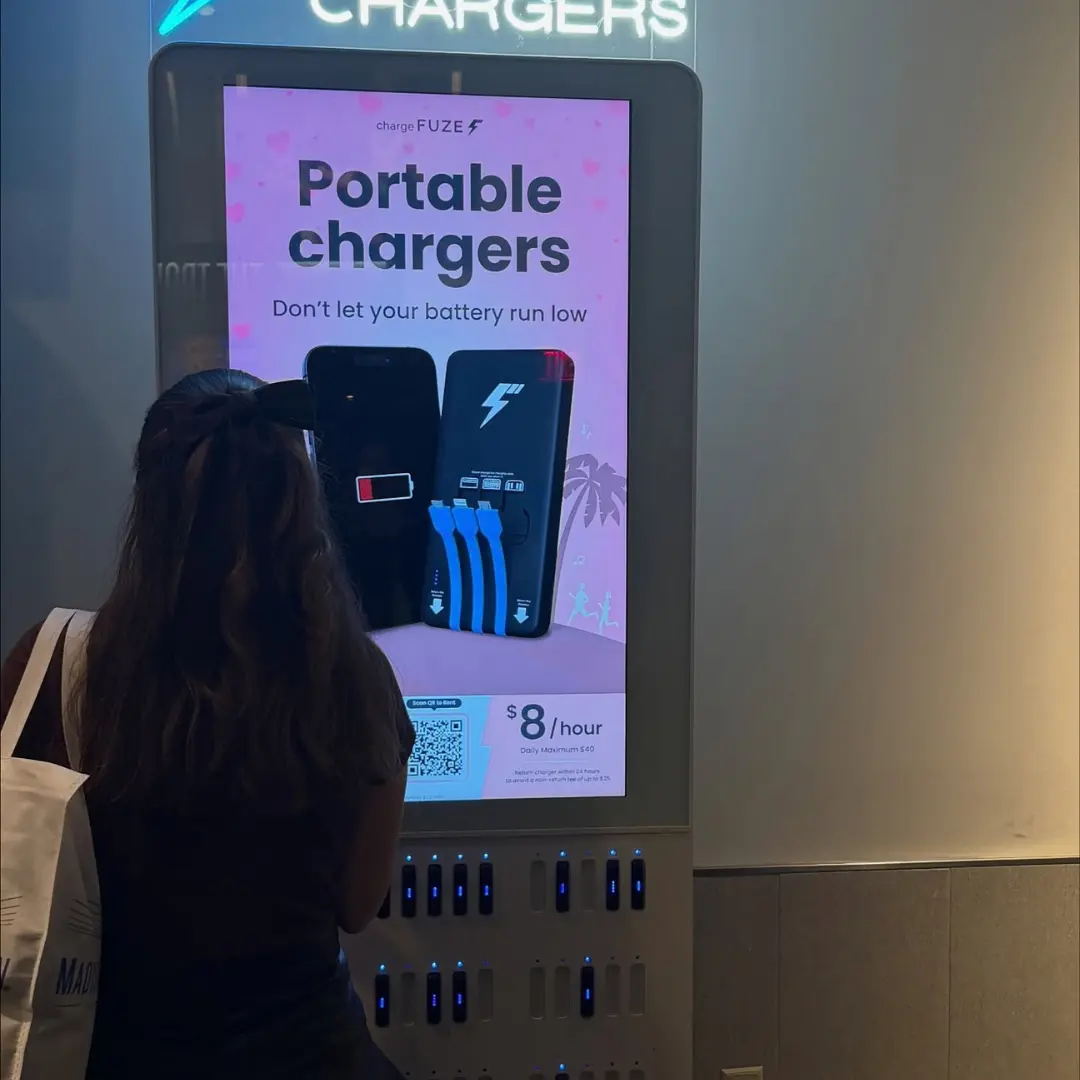
Portable Charging Kiosks
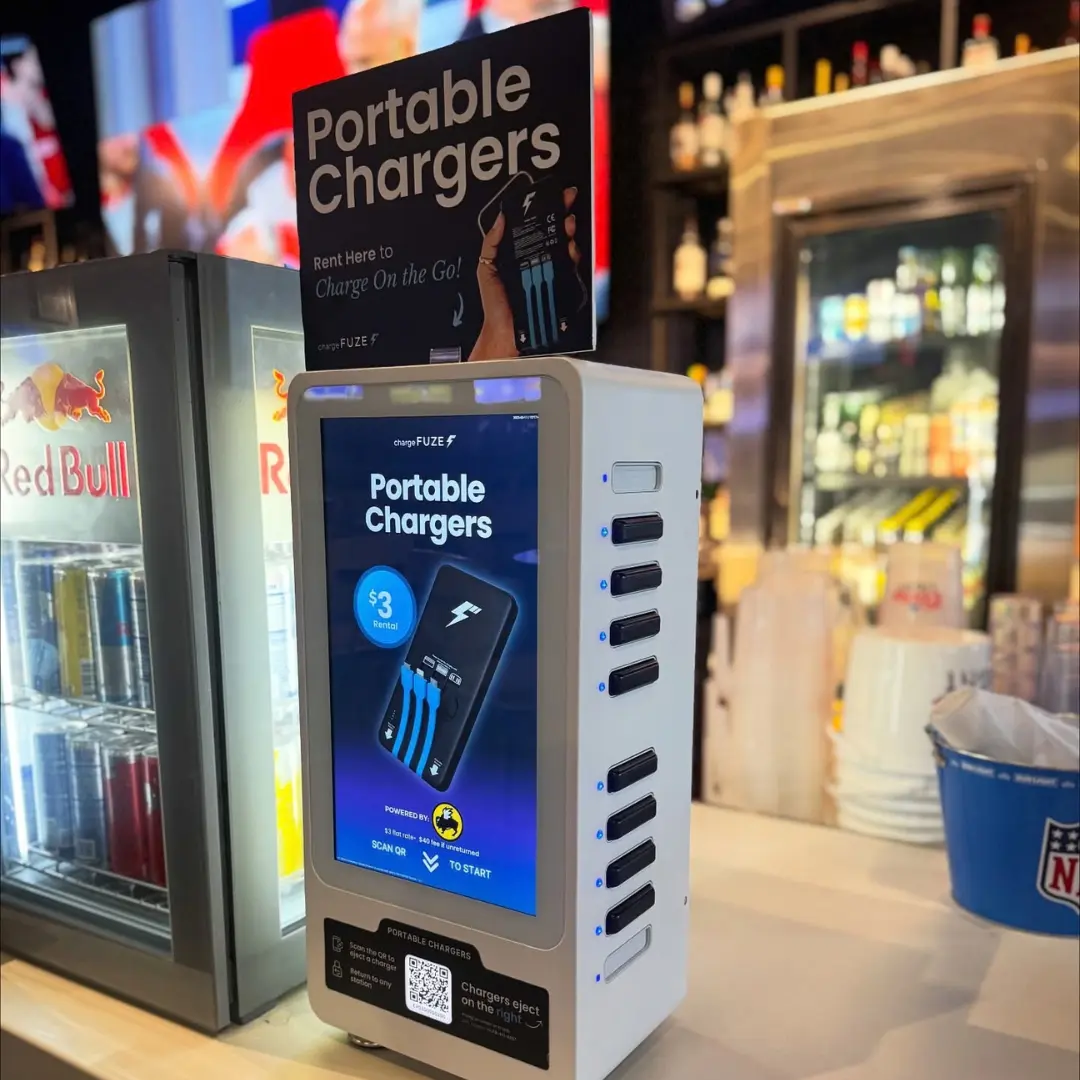
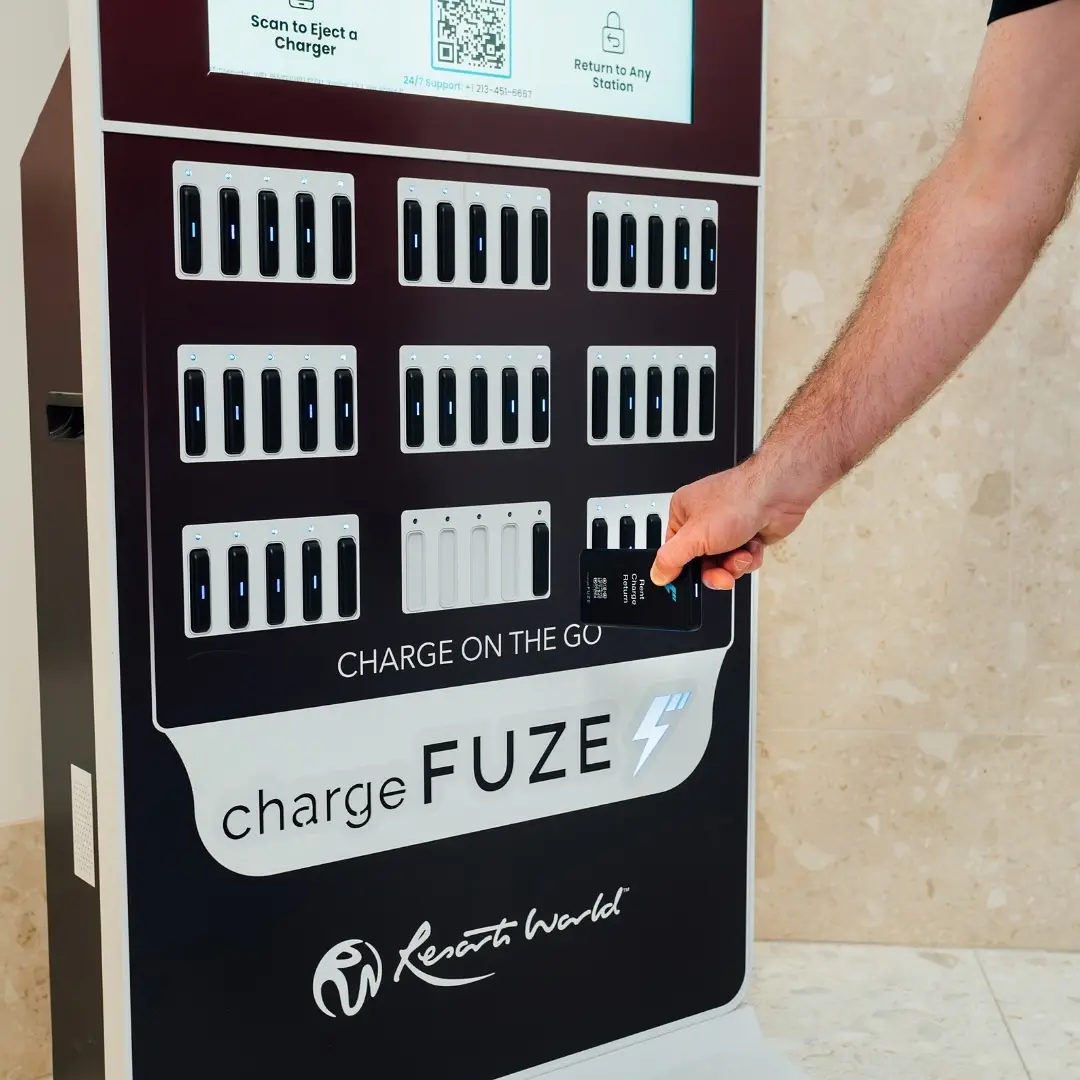
A portable charging kiosk is a freestanding unit that houses multiple rentable power banks. Guests walk up, scan a QR code or use an app, and the kiosk ejects a compact battery pack with built-in cables. They take the power bank with them, charge their phone on the move, and return it to any kiosk in the network when they're done. The guest pays a small rental fee, typically $2 to $5 per session, and the venue earns a revenue share or flat placement fee without handling any transactions directly. ChargeFUZE operates networks spanning thousands of locations, managing everything from hardware maintenance to 24/7 consumer support, keeping the venue's involvement minimal.
Charging Lockers
A charging locker is a stationary unit with individual, lockable compartments. Guests place their phone inside a bay, connect it to a built-in cable, set a PIN or scan a code, and walk away. The phone charges inside the locked compartment until the guest returns to retrieve it. Some locker models are free to use; others charge a per-session fee. Lockers range from compact six-bay wall units to large floor-standing cabinets with 20 or more bays, and many now include digital screens for advertising or wayfinding content.
Wall-Mounted Stations
A wall-mounted charging station is a fixed panel installed on a wall, typically offering multiple charging cables (Lightning, USB-C, Micro-USB) or wireless Qi charging pads. Guests stand or sit near the unit, plug in their device, and wait for it to charge. There's no locker, no power bank to carry, as the phone stays physically tethered to the wall unit for the duration of the charge. Most wall-mounted stations are offered as a free amenity, though some integrate with digital signage or advertising platforms to generate indirect revenue.
Factors That Actually Matter
Guest Mobility
With a portable charging kiosk, the guest grabs a power bank and leaves. They keep exploring the venue, ordering food, browsing merchandise, watching the show, or walking the trade show floor, all while their phone charges in their pocket. There is zero tethering. This is critical in any environment where movement correlates with spending.
With a charging locker, the guest gets their phone back fully charged, but they surrender it for the entire charging duration, typically 30 to 60 minutes. During that time, they can't check messages, take photos, use mobile payments, navigate the venue, or post on social media. With a wall-mounted station, the guest is physically anchored to the wall. They can't move more than a cable's length from the unit. This creates a fundamentally static experience that works in waiting rooms or airport gate areas but actively fights the goals of any venue that profits from guest movement.
Throughput and Capacity
A portable charging kiosk with 12 to 48 power bank slots can theoretically serve its full capacity within minutes, since each interaction takes under 30 seconds. Once a power bank is out, the slot is available again when another guest returns a battery. High-traffic kiosks can cycle through dozens of rentals per day from a single unit. A charging locker's throughput is constrained by charge time. If a locker has 12 bays and each phone occupies a bay for 45 minutes, the unit serves a maximum of roughly 16 guests per bay per 12-hour day, assuming perfect turnover with no idle time. Guests often leave their phones on longer than necessary, further reducing effective throughput.
Wall-mounted stations face similar constraints. If a unit has six cables and the average charge time is 30 minutes, the maximum throughput is about 12 guests per cable per 12-hour day. But because guests must stay nearby, the stations also create congestion in the immediate area, a secondary capacity issue that lockers and kiosks don't share.
Guest Experience and Satisfaction
68% of venues with charging stations report increased customer engagement , and charging customers spend 29% to 37% more time on premises than non-charging visitors. But the quality of that experience differs by model.
- Portable kiosks deliver the highest-rated guest experience in mobile-first environments because they don't interrupt what the guest came to do. A festival attendee keeps dancing. A hospital visitor keeps sitting with their family. A bar patron keeps ordering drinks. The charging happens invisibly, in the background, while the guest's experience continues uninterrupted.
- Charging lockers deliver a satisfactory experience for guests who are willing to part with their phones temporarily. The security element is appreciated, knowing the phone is locked and charging provides peace of mind.
- Wall-mounted stations deliver the most friction-heavy experience. The guest gets a charge, but they pay for it with their time and mobility. In environments where guests are already stationary, this tradeoff is acceptable. In environments built around movement and exploration, it actively undermines the venue's goals.
Security and Liability
Guest anxiety about phone theft is real, and each model handles it differently.
- Portable kiosks eliminate the concern entirely. The phone never leaves the guest's hands. They're charging from a battery pack in their pocket or bag. There is nothing to steal and nothing to worry about.
- Charging lockers address security through physical enclosure. The phone is locked behind a door, accessible only via PIN or QR code. Forgotten PINs, malfunctioning locks, or a guest who claims their phone was damaged in the locker all create liability scenarios that fall to the venue. Locker providers typically include insurance or indemnification clauses, but the venue still absorbs the reputational cost of a negative experience.
- Wall-mounted stations offer the least security. The phone sits on an open shelf or hangs from a cable in a public area. Guests either hover nearby to guard their device, defeating the purpose of the amenity. Some wall units include short tether cables to deter grab-and-run theft, but these are deterrents, not solutions.
Matching the Model to Your Venue Type
Here's how they translate into practical recommendations by venue category.
- Bars, restaurants, and nightlife venues. Guest mobility is paramount. Patrons are socializing, ordering, and moving between tables and bars. A portable charging kiosk is the strongest fit because it keeps guests active and spending. A wall-mounted station near the hostess stand or in the restroom hallway can serve as a secondary option for quick top-ups, but it shouldn't be the primary solution.
- Hotels and resorts. These venues benefit from a blended approach. Portable kiosks in lobbies, pool areas, and event spaces let guests charge on the move. A small charging locker near the concierge desk or fitness center is available for guests who want to stow their phone during a workout or spa visit. Wall-mounted stations in conference rooms and business centers provide fixed charging where guests are already seated.
- Shopping malls and retail environments. The goal is to keep shoppers moving through stores, not parked next to a wall outlet. Portable kiosks placed at entrances, food courts, and anchor-store corridors directly support this goal. Research from a regional mall chain found that charging lounges increased average visitor duration by 43 minutes, with a corresponding per-visitor spending increase of $23. That ROI multiplies when the charging solution is portable rather than stationary.
- Stadiums, arenas, and concert venues. These are high-density, high-emotion environments where guests are checking scores, posting to social media, and coordinating with friends via text. Separating them from their phones (lockers) or tethering them to a wall (mounted stations) is counterproductive. Portable kiosks are the clear winner here, with the added benefit of branded power banks that put a sponsor's logo in every guest's hand. chargeFUZE has deployed this model at major events drawing hundreds of thousands of attendees, demonstrating the scalability portable kiosks offer at the highest traffic volumes.
- Hospitals and healthcare facilities. Patients and visitors may be stationary for hours, making lockers and wall-mounted stations viable. But family members who move between floors, waiting rooms, and cafeterias benefit significantly from portable power banks. A mixed deployment covers the broadest range of needs.
- Airports and transportation hubs. Travelers are time-anxious and movement-heavy. They shuttle between check-in, security, gates, lounges, and retail areas. Portable kiosks align best with this behavior, though wall-mounted stations at gate seating areas provide a useful complement for travelers who've reached their final waiting spot.
- Corporate offices and coworking spaces. These environments are lower-traffic and more predictable. Wall-mounted stations in conference rooms and common areas typically suffice, possibly supplemented by a small charging locker in the lobby for visitor convenience.
- Trade shows, conferences, and temporary events. Portable kiosks are virtually the only practical option for temporary deployments. They require no installation, no construction, and no permanent infrastructure. A single standard outlet per unit is all that's needed, and the units can be repositioned between sessions as traffic patterns shift.
- Gyms and fitness centers. Members don't want to bring their phones onto the gym floor, but they also don't want to leave them unattended in a cubby. Charging lockers are a natural fit here. Members can lock their phone, complete their workout, and retrieve a fully charged device afterward. A small portable kiosk near the front desk serves members who prefer to keep their phones with them during cardio sessions.
- Universities and educational campuses. Students are mobile, tech-dependent, and perpetually low on battery. Portable kiosks in student unions, libraries, and dining halls address the highest-traffic needs. Wall-mounted stations in lecture halls and study rooms serve the seated-use case. Lockers near exam halls offer a secure charging option during testing periods when phones must be stowed.
The first question is whether the provider covers hardware maintenance, replacements, and software updates at no additional cost to the venue, or whether those responsibilities and costs transfer to your team. The second is whether the solution generates direct revenue for your venue and, if so, what the realistic per-month projection looks like based on comparable venues, not best-case hypotheticals. Third, ask about the minimum commitment term and what happens if the solution underperforms. A provider confident in their product will offer a pilot period or an easy exit clause. Fourth, consider scalability: if the initial deployment succeeds, how quickly and at what cost can you add more units? And fifth, ask for references from venues of similar size and type. A provider who can't connect you with a happy customer at a comparable location is a provider you should approach with caution.
The cell phone charging station market was valued at over $500 million in 2024 and is growing at double-digit compound annual rates. That growth means more options, more competition among providers, and better terms for venues willing to do their homework. The venue that chooses the right model for its specific context won't just keep guests' phones alive. It'll keep those guests engaged, spending, and coming back.
Sources
- Global Growth Insights – Cell Phone Charging Station Market Size & Forecast, 2033
- Data Horizon Research – Cell Phone Charging Station Market Size, Growth and Analysis Report, 2033
- Future Market Report – Cell Phone Charging Kiosk Market Size, Share, Growth, CAGR Forecast 2032
- Verified Market Reports – Cell Phone Charging Kiosk Market Size and Forecast
- Cognitive Market Research – Global Mobile Phone Charging Station Market, 2024
- Industry market research – Public Phone Charging Location analysis (dwell time and spending data)
- chargeFUZE – Understanding Portable Charging Kiosks
- chargeFUZE – Increase Dwell Time and Sales with Business Charging Stations
- chargeFUZE – Phone Charging Stations for Customer Dwell Time
- The Power Stop – Public Mobile Charging Stations: What You Should Know
- VISCHARGE UK – Pros and Cons of Free Phone Charging Stations vs. Paid Phone Charging Lockers
- Displays2Go – Floor Standing Charge Stations
- Displays2Go – Multi-Device Charging Lockers
- ECM Media LLC – How to Optimize Phone Charging Stations at Your Event
