
Text +1 (213) 928-7320
Let's chat!

Commercial Phone Charging Stations: Types, Costs, and Key Features
Every venue operator has seen guests hovering near outlets, trailing cables across walkways, or simply leaving early because their phone hit single digits. Low battery anxiety shapes where people go, how long they stay, and how much they spend. That reality has turned commercial phone charging stations from a nice-to-have amenity into a measurable business investment.
Why the Market Is Accelerating And Why It Matters for Your Purchase Timing
The commercial phone charging station market is growing fast enough that waiting too long to enter could mean paying more for the same hardware. The global cell phone charging station market was valued at approximately $507 million in 2024 and is projected to reach $1.8 billion by 2033, growing at a compound annual growth rate (CAGR) of 15.11%.

For buyers, this growth trajectory matters practically. Vendor competition is intensifying, which means better pricing and more options today than even 18 months ago. But it also means that the venues around you are likely already evaluating or installing stations. In high-traffic commercial real estate, more than 60% of North American properties now offer some form of phone-charging solution. Waiting for the "perfect" product risks falling behind a baseline amenity expectation that guests and customers are already forming.
The Five Form Factors: What Each Type Actually Does Well
Tabletop and Countertop Units
These compact stations sit on tables, counters, or reception desks and typically charge 3–6 devices simultaneously via built-in cables or USB ports. They're the lowest-cost entry point, and they work well in restaurants, coffee shops, waiting rooms, and conference tables, anywhere people are already seated.
Wall-Mounted Stations
Wall-mounted units save floor space and work well in corridors, lobbies, restrooms, and narrow retail environments. Installation requires only a standard wall outlet and basic mounting hardware. Wall-mounted stations require people to stand near a wall while their device charges, which limits dwell time unless you pair them with nearby seating. They're best suited as a convenience amenity rather than a destination feature.
Freestanding Kiosks
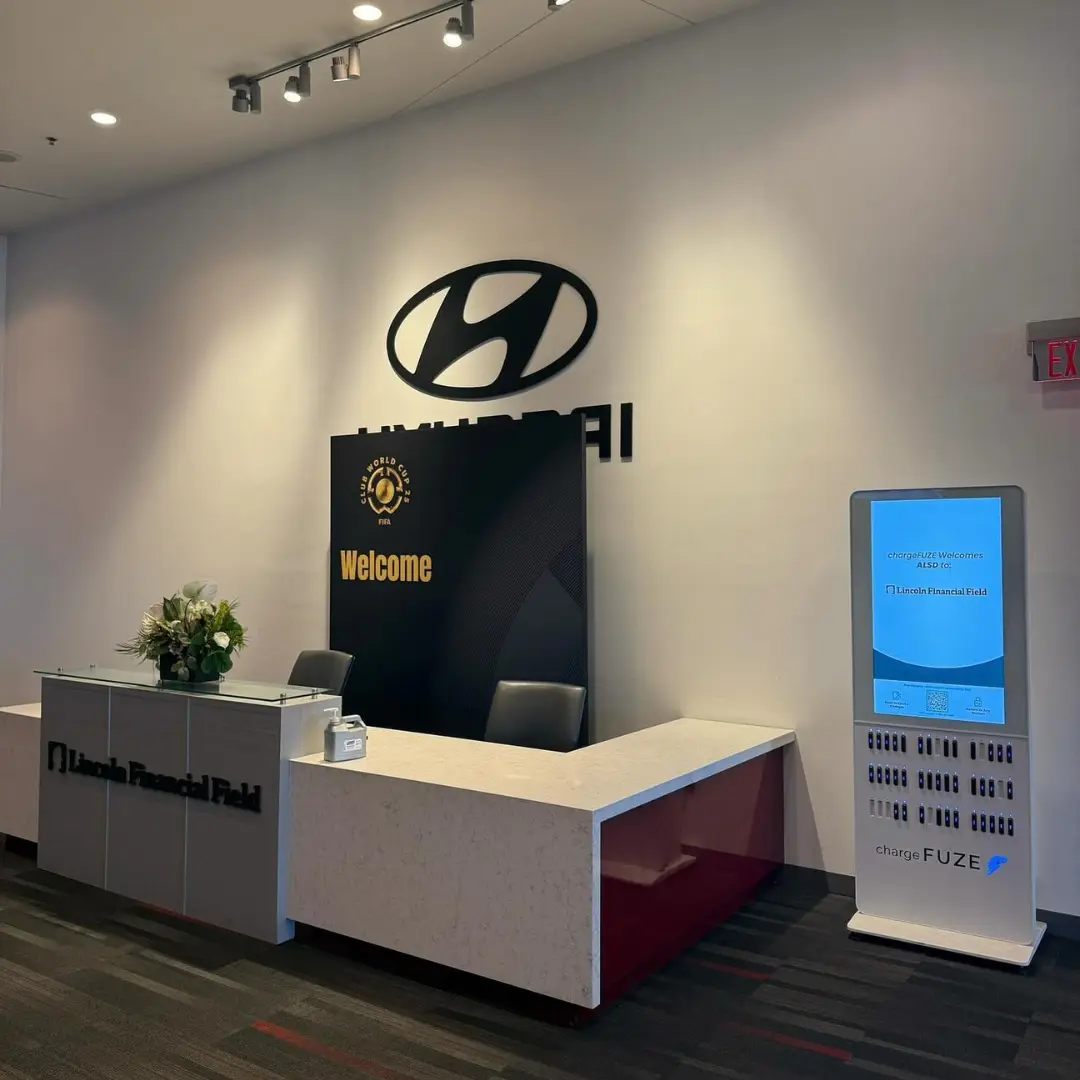
Freestanding kiosks are the most visible and versatile option for high-traffic venues like malls, airports, convention centers, and university campuses. They typically support 6–12 simultaneous charges, offer a mix of USB-A, USB-C, and sometimes Qi wireless pads.
Secure Charging Lockers
Charging lockers address theft and supervision issues by allowing users to lock their devices in a compartment while they charge. Each locker bay typically includes its own cable and lock mechanism (PIN, RFID card, or app-based).
These are the gold standard for events, airports, hospitals, and any venue where guests need to leave their phones unattended. The Coachella Music Festival is a frequently cited case study, as charging lockers recorded over 10,000 device charges across two weekends, generating $30,000 in revenue through branding partnerships alone. The downside is the cost per charging slot, which is significantly higher than that of open kiosks, and the need for more regular maintenance to keep locking mechanisms functioning reliably.
Portable Power Bank Rental Stations
This is the fastest-growing segment of the market. Rental stations let users grab a portable power bank from a kiosk, charge their phone untethered anywhere in the venue, and return the bank to any compatible station later. ChargeFUZE has built extensive networks around this model, deploying stations across major retail centers, hospitality venues, and event spaces.
The rental model has distinct advantages for venue operators. There's often zero or minimal upfront hardware cost if you partner with an established network. The provider installs and maintains the stations, and the venue earns a revenue share on each rental. For businesses with limited floor space, wall-mounted rental kiosks take up very little room. And because users take the power bank with them, dwell time increases without requiring guests to sit next to a stationary charging point. ChargeFUZE's deployment across Westfield Shopping Centers illustrates how major commercial properties are embracing this approach to keep customers engaged and moving through the space rather than tethered to a wall.
Real Pricing: What You'll Actually Pay in 2026
Transparent pricing is the biggest gap in existing guides, so here's a consolidated view based on current market data. These ranges reflect commercial-grade hardware suitable for public deployment.
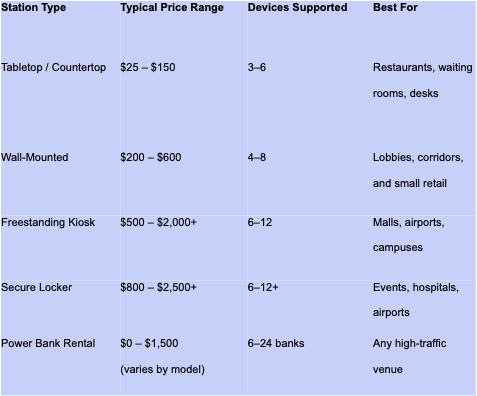
Three things to note about these numbers: they cover hardware only. Installation, electrical work, and ongoing maintenance are additional. Most tabletop and wall-mounted units plug into standard outlets without the need for an electrician, but freestanding kiosks and locker banks may require dedicated circuits, especially if you're deploying multiple units in one area. Power bank rental stations have the widest price variance because their business models vary. A revenue-share partnership with a network might mean zero hardware cost to you, while purchasing stations outright for independent operation will run $500–$1,500 per unit.
Branding and customization also add cost. Custom wraps, branded screens, and digital signage integration can add 20–40% to the base price of kiosks and lockers, but these features are often what convert a charging station from a cost line item into a marketing asset.
The Revenue Case: Dwell Time, Spending Lift, and Advertising Income
Extended Dwell Time Drives Spending
The most replicated finding across retail and hospitality research is that charging station availability directly increases how long customers stay, and longer stays translate to higher spending. Customers who charge their devices typically spend 29–37% more time on premises than non-charging visitors. At the mall level, properties with charging options report a 35% increase in customer dwell time and a 27% boost in user satisfaction.
The spending correlation is concrete. Food service establishments see an average check increase of roughly 17% among users who charge. Retail environments report a sales lift of around 22%. Installing charging lounges increased average visitor time by 43 minutes, with a corresponding per-visitor spending increase of $23.
Direct Monetization
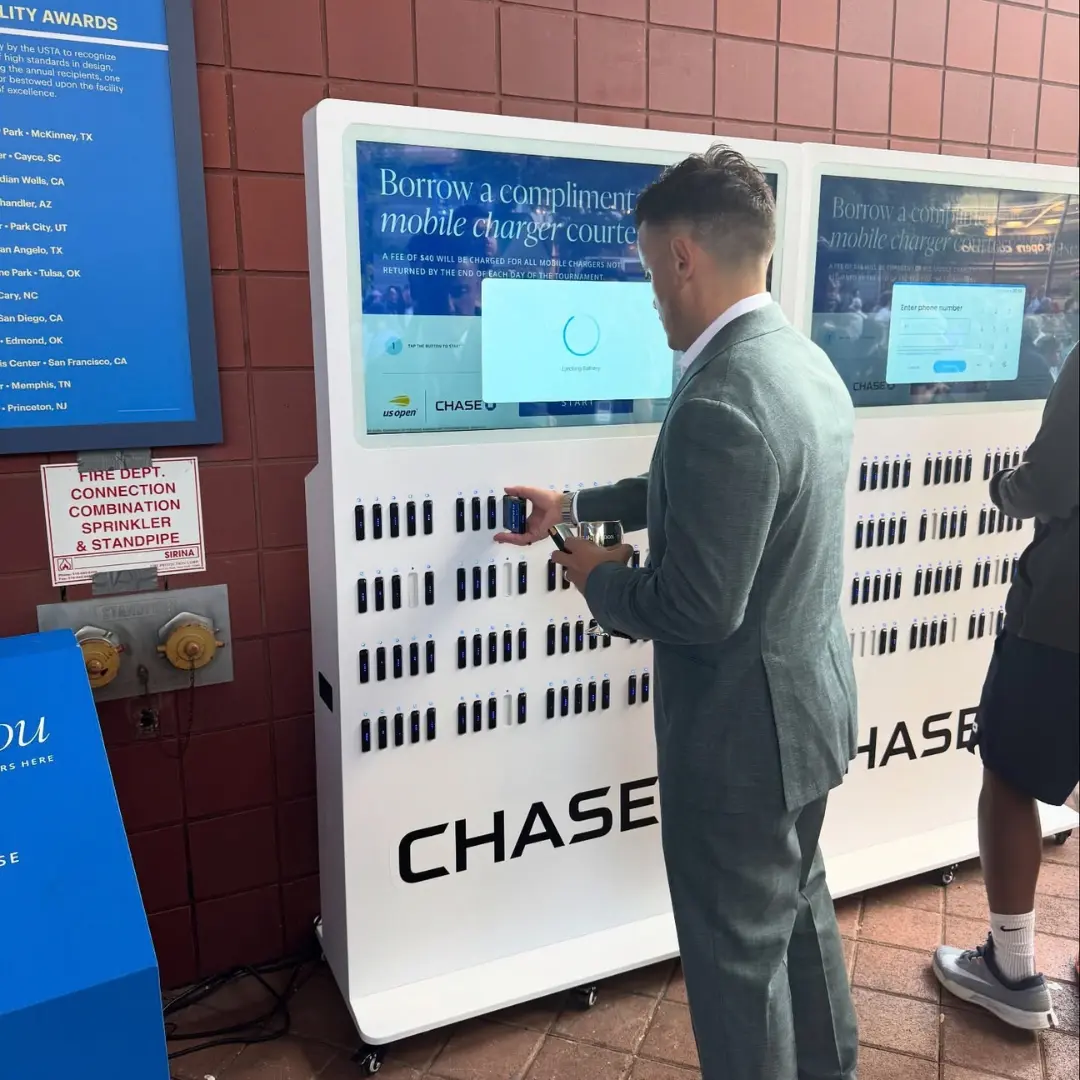
Pay-per-use stations and power bank rentals generate revenue directly. Pricing models vary with flat fees per charge session, time-based rental rates, or subscription passes for frequent visitors. Revenue-share models, particularly common with power bank rental networks, let venue operators earn a portion of each transaction without managing hardware. Some distributor programs offer revenue shares of 30% or more on all rental income, making this a genuinely passive income stream for qualifying venues.
Advertising Revenue
Kiosks and stations with integrated digital screens open a third revenue channel. Brands pay to display ads to a captive audience. Someone standing at a charging station is stationary and looking at a screen. Advertising integration is one of the primary growth drivers for the charging station market, with companies using kiosks for charging devices while displaying targeted promotional content.
Technology to Evaluate: USB-C, Qi2, and What's Worth Paying For
USB-C Power Delivery Is Now Non-Negotiable
Any station you purchase today must support USB-C with Power Delivery (PD). USB-A ports are legacy technology at this point, and the European Union's common charger directive has made USB-C mandatory for new devices. The practical effect is that USB-C is now the universal standard globally. Stations that only offer USB-A cables or ports will feel dated within a year and frustrate an increasing share of your users. Look for PD output of at least 20W per port for meaningful fast charging. Cheaper stations may advertise USB-C but deliver only 5W or 10W, which is barely faster than a trickle charge on modern smartphones.
Qi2 Wireless Charging Is Worth the Premium — With Caveats
The Qi2 wireless standard, which incorporates magnetic alignment and supports charging speeds up to 25W with the Qi2.2 update, is becoming standard on flagships from Apple, Samsung, Google, and other major manufacturers. The Qi2 25W standard boosts power delivery by nearly 70% over previous wireless generations while cutting energy waste by up to 30% through better magnetic alignment.
For commercial stations, Qi2 wireless pads eliminate the cable damage problem that plagues public USB ports. But wireless charging is slower than wired USB-C PD for most devices, and it requires users to place their phone flat on a pad, which limits mobility. Prioritize USB-C PD for your primary charging infrastructure and add Qi2 wireless pads as a supplementary option on kiosks and tabletop units where the form factor supports it.
GaN Charger Modules and Power Efficiency
Behind the scenes, Gallium Nitride (GaN) chip technology is making charging hardware smaller, cooler, and more efficient. GaN-based power supplies deliver the same wattage as traditional silicon chargers in a significantly smaller footprint and generate less heat. For commercial stations running 8–12 ports simultaneously, this translates to lower electricity costs and longer hardware lifespan.
Security and Liability: The Juice Jacking Question
If you've researched public charging infrastructure, you've encountered juice jacking. This is the theoretical attack where a compromised USB port installs malware on or steals data from a connected device. The FBI's Denver office and the FCC both issued public warnings about juice jacking in April 2023, advising travelers to avoid public USB ports.
The good news is that mitigating the juice jacking concern is inexpensive. Use charge-only USB cables with the data pins physically disconnected. These cost pennies more than standard cables and prevent data transfer at the hardware level. Choose stations that advertise data-blocking technology as a built-in feature. And for secure locker deployments, the locked enclosure itself adds a layer of tamper resistance.
Beyond juice jacking, your more practical security concerns are physical theft of devices from open charging stations and vandalism of the hardware itself. Secure lockers address the first problem. For freestanding kiosks, select models with tamper-resistant enclosures and consider placement within staff or security camera sightlines. Train your team to conduct brief visual inspections during routine walkthroughs.
Installation Planning: Power, Placement, and Maintenance Realities
Electrical Requirements
Tabletop and wall-mounted stations plug into standard 120V outlets and draw modest power, typically 50–100 watts total. No electrical upgrades needed in most cases. Freestanding kiosks and locker banks are a different story. A 12-port kiosk delivering 20W per port draws up to 240W under full load, and digital signage screens add another 50–150W. Consult an electrician before installation to avoid tripping breakers during peak usage.
Placement Strategy
Place stations where people naturally pause or wait: near entrances and exits, beside seating areas, at food courts, adjacent to restrooms, and in queuing zones. Visibility is critical. A station tucked behind a pillar or down a side hallway won't get used, regardless of how badly people need a charge. For revenue-generating kiosks with digital screens, placement becomes even more strategic. High-traffic corridors with forced foot traffic maximize daily advertising impressions.
Ongoing Maintenance
The most common issues, in order of frequency, are cable damage and theft (for wired stations), software glitches on digital screens, and jammed locker mechanisms. For wired stations, plan to replace cables every 2–4 months in high-traffic deployments, as this is a consumable cost, not a one-time expense. Wireless Qi pads largely eliminate this problem, which is one reason to include them even at a higher upfront cost. Revenue-share network models shift most of the maintenance burden to the provider, a significant hidden benefit of the rental power bank approach. Ask potential partners about their average station uptime rate and response time for hardware issues before signing.
Making the Decision
Rather than recommending a single "best" station, here's a decision framework that maps your priorities to the right form factor.
- If your primary goal is guest satisfaction at minimal cost, tabletop units in seating areas give you the biggest impact per dollar. Restaurants, medical waiting rooms, and coworking spaces fit this profile.
- If you want to generate direct revenue, power bank rental networks or pay-per-use lockers offer the clearest path. Airports, entertainment venues, and large retail properties fit this profile.
- If advertising and brand visibility are priorities, freestanding kiosks with integrated digital signage serve double duty. Malls, convention centers, and transit hubs fit this profile.
- If security is the top concern, secure lockers with PIN or app-based access are the only real option. Hospitals, gyms, theme parks, and music festivals fit this profile.
- If floor space is extremely limited, wall-mounted stations or compact rental kiosks keep your footprint minimal. Boutique retail, cafes, and small hospitality venues fit this profile.
Whatever you choose, start with one or two units in your highest-traffic location, measure usage for 60–90 days, and scale based on actual data rather than projected demand. The market is moving fast, pricing is competitive, and the technology will continue improving, but your customers' phones are dying right now.
Sources:
- Global Growth Insights — Cell Phone Charging Station Market Size & Forecast 2033
- Verified Market Research — Mobile Phone Charging Station Market Size
- Business Research Insights — Cell Phone Charging Station Market Size, Share, Forecast
- CBS News — FBI Warns Against Juice Jacking
- FCC — What Is Juice Jacking and Tips to Avoid It
- Snopes — How Serious Is the Threat of Juice Jacking?
- Malwarebytes — Juice Jacking Warnings Are Back, With a New Twist
- Tech Times — Fast Charging in 2025: Wired, Wireless, or Magnetic?
- Wawt.tech — Qi2 25W Wireless Charging: Tech, Ecosystem & Market Outlook
- The Power Stop — How Cell Phone Charging Kiosks Boost Customer Experience in Hospitality and Retail
- Retail & Restaurant Facility Business — ChargeFUZE to Roll Out in Westfield Shopping Centers
- Scoop Market — Cell Phone Charger Statistics: New Charging Tech 2026
