
Text +1 (213) 928-7320
Let's chat!

Charging Kiosks as a DOOH Advertising Channel: What Brands and Media Buyers Should Know
Digital out-of-home advertising surpassed $20 billion in global revenue in 2024 and is on pace to nearly double by 2030. Most of that growth is coming from the displays embedded in gyms, lobbies, retail checkout lanes, and transit hubs where consumers are stationary, receptive, and difficult to reach through any other channel. For media buyers building omnichannel plans, the challenge has shifted from finding digital inventory to finding digital inventory that actually holds attention. That is where phone charging kiosks enter the conversation.
Charging kiosks sit in high-traffic venues, and they serve an audience that is, by definition, waiting. Users interact with the station for anywhere from a few seconds to several minutes while retrieving or returning a portable charger, and the screen in front of them is the only content competing for their attention during that window. For brands evaluating where to allocate DOOH budget, this format offers a combination of dwell time and audience quality that most place-based screens cannot match. This article breaks down what advertisers and media buyers need to know before adding charging kiosk networks to a media plan: how impressions are priced, what audiences these screens reach, how to buy inventory programmatically, and how to measure results using the same attribution frameworks already applied to other DOOH formats.
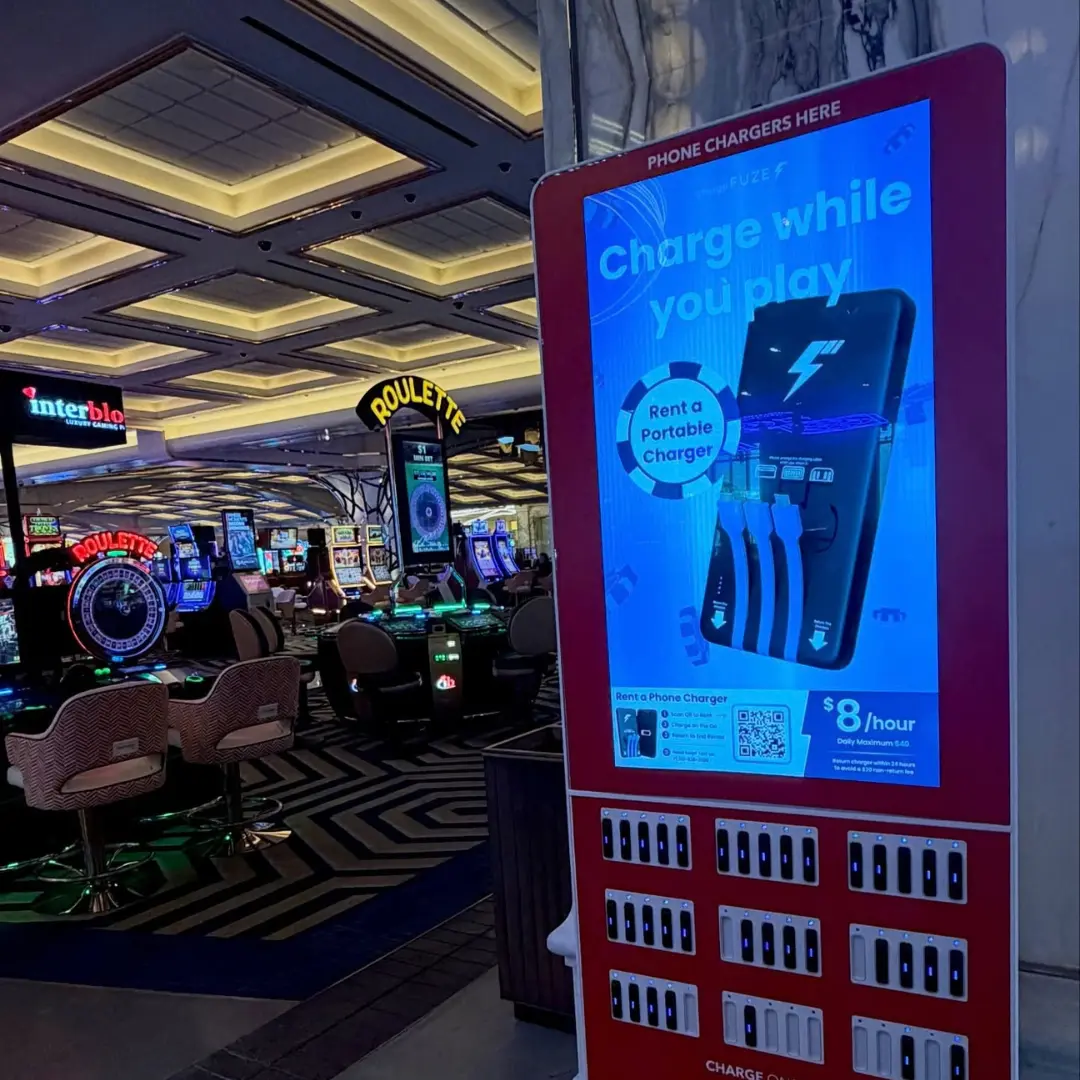
Why Charging Kiosk Screens Deserve a Line Item
These displays create a unique form of digital out-of-home advertising that combines high-intent audiences and contextual relevance. The advertising capability of kiosk screens often deserves its own revenue category when evaluating the total business potential of a charging network:
- High-Value Demographic Concentration: Most installations appear in entertainment districts, hospitality venues, large retail environments, and urban centers where visitors tend to fall within the 21 to 45 age range. These environments also attract professionals, travelers, and consumers with above-average disposable income. Research from the OAAA and The Harris Poll shows strong favorability toward digital out-of-home advertising among millennials, Gen Z, urban residents, and male consumers. Because these demographics align closely with kiosk users, the screens reach a concentrated segment of high-value audiences.
- Extended Attention Windows: Traditional outdoor advertising relies heavily on quick visual impressions. A highway billboard might capture only a two-second glance, while a transit shelter display may receive several seconds of passive attention. Users may spend 15 seconds retrieving a charger, scanning instructions, or navigating prompts, and sometimes remain nearby while companions finish transactions. This longer engagement period dramatically increases confirmed exposure.
- Utility-Driven Brand Context: Advertising effectiveness often improves when the message appears within a positive user experience. Charging kiosks deliver exactly that environment because they provide a helpful service when a consumer needs it most. When someone rents a charger, the screen becomes associated with convenience and problem-solving rather than interruption. This positive service context creates a halo effect for any brand message displayed. Ads appearing during this interaction benefit from a receptive mindset, which often leads to stronger recall and greater openness to promotional messages.
- Action-Oriented Advertising Opportunities: The interactive nature of charging kiosks enables advertising formats that go beyond simple brand impressions. Screens can display QR codes, promotional offers, event announcements, or mobile app prompts that users can immediately act on while standing at the kiosk.
- Premium CPM Potential: Because charging kiosks combine targeted demographics, verified dwell time, and contextual engagement, advertisers often treat them as premium digital out-of-home inventory. Screens positioned in nightlife districts, airports, shopping centers, and stadium environments provide predictable exposure to valuable audiences. Media buyers frequently pay higher CPM rates for formats that deliver confirmed viewing rather than estimated impressions.
When evaluated together, these advantages explain why charging kiosk screens deserve their own line item in any business model. The advertising component transforms kiosks from simple utility stations into dual-purpose assets that generate both rental income and media revenue.
CPM Benchmarks: Where Charging Kiosks Fit in the DOOH Pricing Landscape
Understanding pricing is essential for any media buyer evaluating a new format. The average programmatic DOOH CPM across all venue types reached $7.62 in the second half of 2024, according to Place Exchange data. That figure represents a meaningful increase from $7.16 in the first half of the same year, driven by rising demand for place-based inventory. Roadside digital billboards typically fall between $5 and $15 in general markets. Transit screens range from $8 to $25, depending on whether the placement is a bus shelter or an airport terminal. Place-based networks in gyms, offices, and retail environments command CPMs between $10 and $30, with checkout-adjacent screens in retail settings reaching even higher.
Charging kiosk screens fit naturally within the place-based network tier. Depending on venue type and screen size, expect CPMs in the $8 to $20 range for programmatic buys, and potentially higher for direct or sponsored placements in premium locations such as major event venues or airport terminals. That pricing is competitive with elevator lobby screens and in-store retail displays while offering a more targeted interaction moment.
For media buyers accustomed to comparing DOOH against other digital channels, the broader context is worth noting. DOOH CPMs generally run comparable to online video and slightly above standard display, but the impression quality is fundamentally different. DOOH impressions are unskippable, unblockable, and delivered to a physically present audience, which is why 73 percent of consumers view DOOH ads favorably, significantly higher than television (50 percent), social media (48 percent), or online display (37 percent).
Audience Profile: Who Uses Charging Kiosks
Building an effective DOOH media plan requires knowing not just where screens are located but who is standing in front of them.
- Mobile-first consumers. More than 72 percent of consumers report experiencing battery anxiety when they are away from home, and over 60 percent say the availability of a charging station influences how long they stay at a venue. These are people whose daily lives revolve around their smartphones.
- Out-of-home spenders. Charger kiosks are deployed in venues where people are actively spending money: restaurants, bars, retail stores, event spaces, and travel hubs. Malls that provide charging options report a 35 percent increase in customer dwell time and a 27 percent boost in satisfaction scores. For advertisers in categories like QSR, beverage, personal care, entertainment, and financial services, this is a consumer in spending mode who is physically close to a point of sale.
- Younger demographics. While smartphone ownership spans every age group, the heaviest users of charging kiosks tend to be millennials and Gen Z consumers who rely on their devices for everything from payments to navigation to social media. This aligns with the audience segments that media buyers increasingly struggle to reach through traditional channels. The same OAAA study found that 74 percent of mobile device users took action on their phones after seeing a DOOH ad, making the phone-in-hand moment at a kiosk an especially powerful bridge between physical exposure and digital conversion.
How to Buy Charging Kiosk Inventory Programmatically
Programmatic DOOH has matured rapidly. In the United States, programmatic transactions expanded 34 percent in 2024, and industry projections suggest the format will account for 65 percent of total US DOOH spending by 2029. For media buyers, this means charging kiosk inventory is increasingly accessible through the same DSPs and workflows they already use for display, video, and CTV.
The buying process mirrors the standard programmatic DOOH process. An advertiser defines campaign parameters within a DSP. The DSP then connects to one or more supply-side platforms (SSPs) that represent charging kiosk screen networks alongside other DOOH inventory. Impressions are transacted through one of three mechanisms:
- open exchange
- real-time bidding
- private marketplace deals with negotiated floor prices
For media buyers activating charging kiosk inventory, the most effective path is usually to negotiate a PMP deal directly with the screen network or through an aggregator, rather than relying on open-auction dynamics.
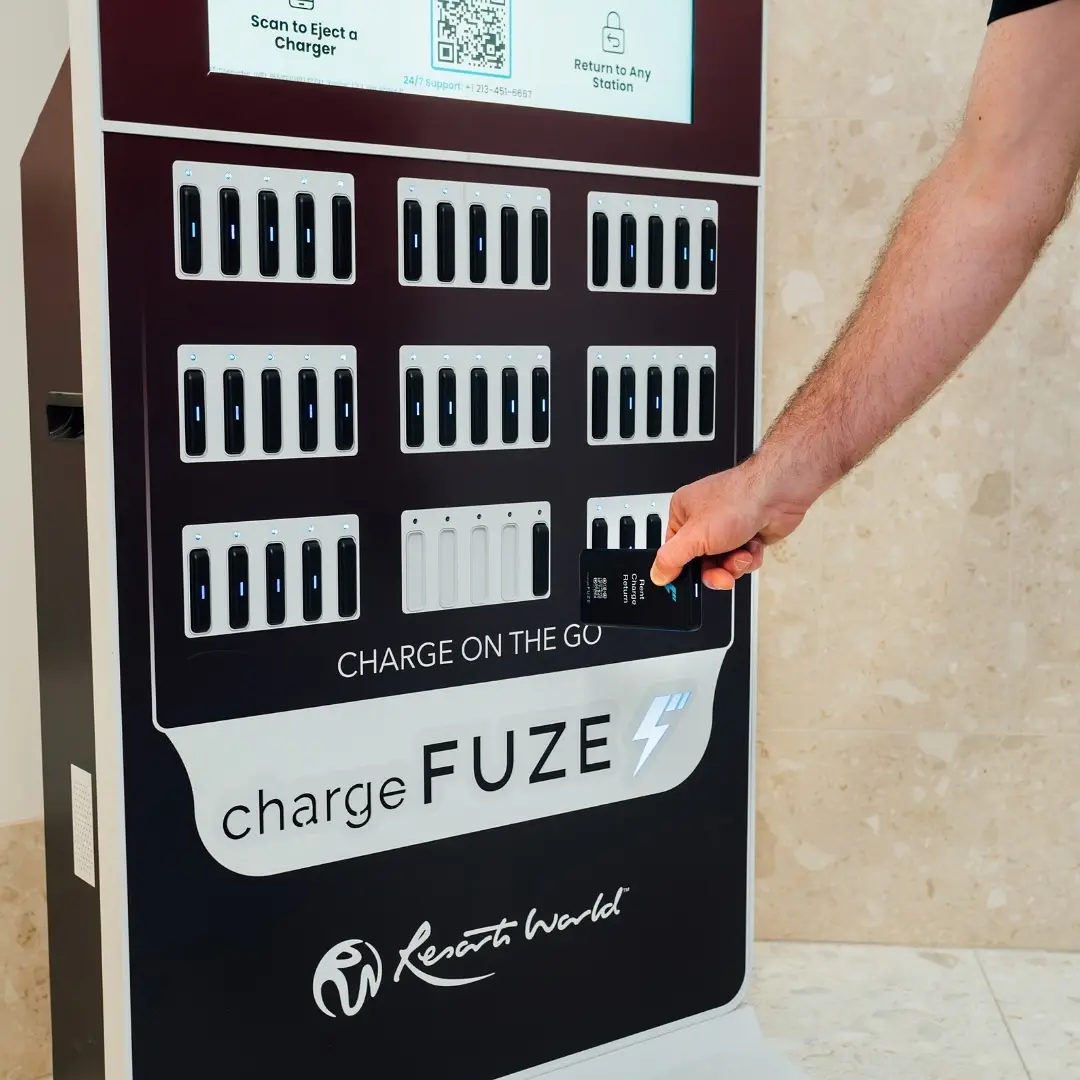
Several practical considerations apply when buying this format. Most charging kiosk screens are vertical and relatively compact compared to billboards or large-format transit displays. Creative assets should be designed for portrait orientation with bold visuals, concise messaging, and a clear call to action. Fifteen-second video slots remain the dominant format across all programmatic DOOH, representing 61 percent of video ad spend, so plan creative accordingly. Charging kiosk networks often offer venue-level geo-targeting, allowing advertisers to select specific locations rather than buy broadly across an entire metro.
Measurement and Attribution: Proving DOOH Works
Impression verification is the foundation. DOOH impressions are estimated using a combination of venue foot traffic data, mobile device signals, and impression multipliers that account for the number of viewers per ad play. Standardized methodologies from organizations like Geopath in the United States provide audited multiplier data that buyers can use to validate delivery reports. Charging kiosks have a measurement advantage here because interaction with the station creates a confirmed presence signal that is more precise than passive foot traffic estimation.
Brand lift studies measure shifts in awareness, recall, consideration, and purchase intent among audiences exposed to a DOOH campaign versus a control group. Such studies are available through DSP partners and third-party measurement firms. Footfall attribution connects DOOH ad exposure to physical store visits. Using anonymized mobile device data, measurement partners can determine whether consumers exposed to a charging kiosk ad subsequently visited a retail location, restaurant, or other point of interest.
Device ID passback is an advanced capability that allows advertisers to receive anonymized device IDs of consumers exposed to their DOOH campaign. These IDs can then be used to retarget exposed audiences across mobile, display, CTV, social, and audio channels. Such capability transforms a single DOOH impression into the starting point of a multi-touch attribution sequence.
QR code and NFC engagement offer direct response measurement. Charging kiosk screens are uniquely positioned for these interactions because users are already holding their phones and standing within arm's reach of the display. QR code campaigns achieve significantly higher engagement rates than standard digital ads because scanning requires an intentional action by a physically present consumer, and each scan is a trackable conversion event.
Creative Best Practices for Charging Kiosk Screens
Designing for charging kiosk screens is not the same as designing for a billboard or even a standard place-based display. Keep it short and visual. Even though dwell times at charging kiosks are longer than at most DOOH placements, the most effective creative still delivers its core message within the first three to five seconds. Lead with a bold visual, a clear brand identifier, and a single benefit statement. Save detailed messaging for the companion digital touchpoints that the campaign drives users toward.
Charging kiosk viewers are typically standing within two to four feet of the screen. That close viewing distance means fine detail, smaller text, and subtle visual elements are more legible than they would be on a billboard viewed from 100 feet away. Take advantage of this by incorporating richer product imagery, readable promotional codes, or QR codes that users can scan without squinting.
Programmatic DOOH platforms support dynamic creative optimization based on time of day, weather, local events, and other real-time signals. A beverage brand can show iced coffee in the afternoon and warm drinks in the morning. A rideshare service can push surge-free ride offers during event let-out times. Charging kiosk screens are especially well-suited for these contextual plays because the venue itself provides a strong contextual signal. A user at a stadium is in a different mindset than a user at an airport. The most measurable charging kiosk campaigns include an action-oriented CTA that links the physical impression to a digital outcome, such as a QR code, short URL, promo code, or app download prompt. Because the user is already holding a charged (or charging) phone, the friction between seeing a CTA and acting on it is lower than in almost any other DOOH environment.
How Charging Kiosks Fit Into an Omnichannel Strategy
Charging kiosks can serve as a strategic link between physical and digital touchpoints. A user sees a brand message on the kiosk screen as they pick up a charger. Minutes later, a retargeted mobile ad reinforces the message on the same device that was just charged. That evening, a CTV ad completes the sequence at home. Sequential exposure across environments is exactly how omnichannel media plans are designed to work, and charging kiosks provide the physical-world anchor point.
Platforms like chargeFUZE, which operate screen-equipped kiosk networks across venues ranging from bars and restaurants to stadiums and convention centers, provide the physical infrastructure that enables this kind of cross-channel activation. Through their adFUZE advertising platform, brands can access programmatic inventory on charging kiosk screens while leveraging the venue-level targeting that makes place-based DOOH effective.
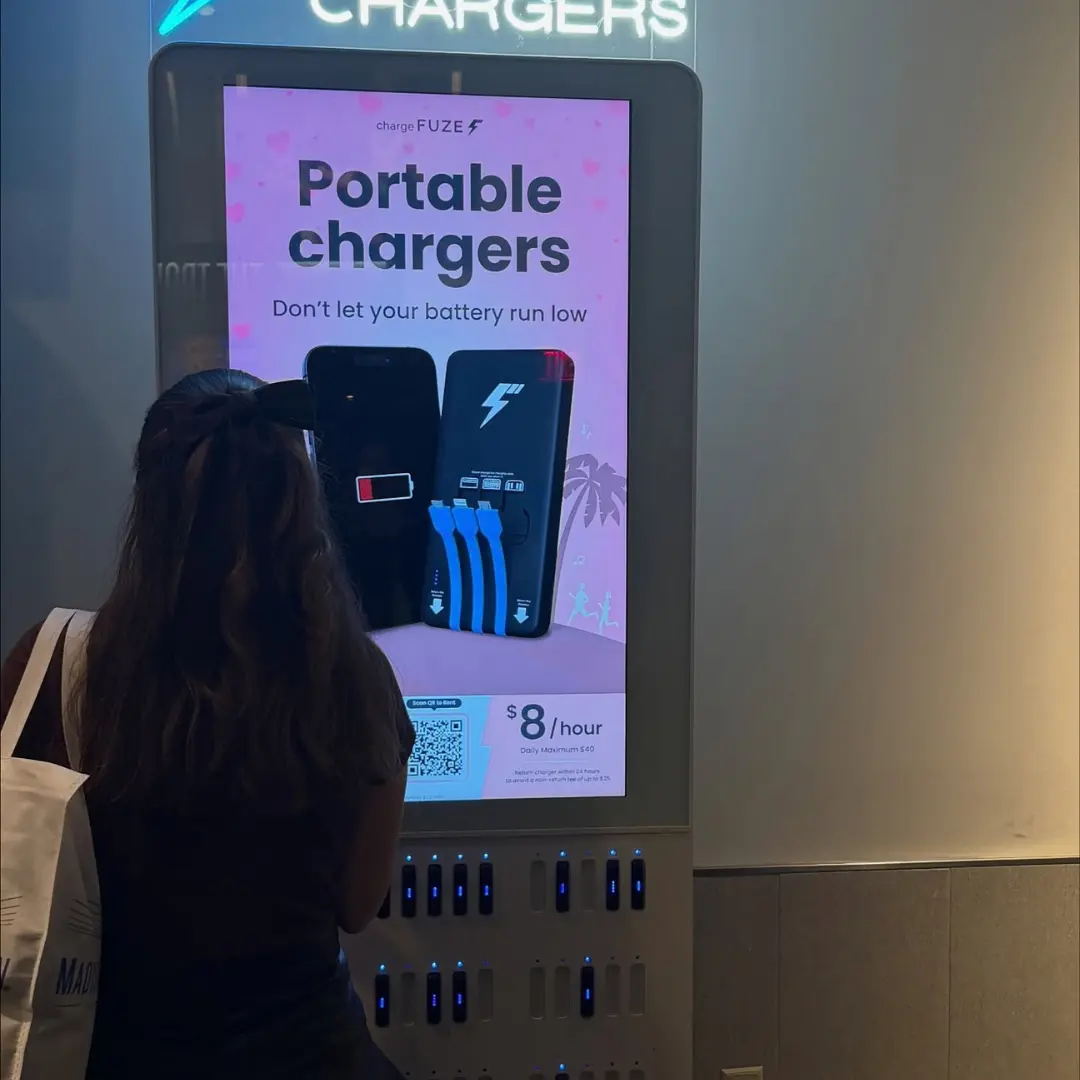
The DOOH landscape is expanding into new environments every quarter. Charging kiosks represent one of the most promising additions to the place-based inventory mix because they combine verified audience presence, meaningful dwell time, and a positive service context that enhances brand perception. For media buyers looking for high-attention, measurable DOOH inventory that integrates cleanly into omnichannel plans, this is a format worth testing—and testing now, before CPMs in the category fully reflect the attention premium these screens deliver.
Sources
- OAAA / The Harris Poll – "The Effectiveness of Digital OOH Advertising" (April 2024)
- Grand View Research – "Programmatic Digital Out-of-Home Market Size Report, 2030"
- Global Growth Insights – "Cell Phone Charging Station Market Size & Forecast, 2033"
- Broadsign – "What Is Programmatic DOOH (pDOOH) Advertising?" (February 2025)
- StackAdapt – "DOOH Measurement: Techniques and Performance Metrics" (November 2024)
- Marketing Dive – "Why Attention Metrics Matter in DOOH Advertising" (May 2025)
- Vistar Media – "Measurement in Advertising: Why DOOH Deserves a Spot in Your Attribution Strategy"
- ExchangeWire – "Going All Out on OOH: What Will 2026 Bring?" (December 2025)
- StackAdapt – "OOH Advertising Stats Every Marketer Should Know" (November 2025)
- chargeFUZE – adFUZE DOOH Advertising Platform (chargefuze.com/adfuze)
- eMarketer – "DOOH Ads Drive Action from 76% of People Who View Them" (May 2024)
