Text +1 (213) 928-7320
Let's chat!

How to Plan Mobile Charging Stations for a Multi-Day Conference or Expo
Day one of a conference looks nothing like day three. Here is how to place, size, power and brand phone charging stations so attendees stay charged from the opening keynote to the final session.

The verdict
Plan charging the way you plan catering: one day at a time. Map where attendees wait and gather, size stations for each day's busiest hour rather than total registrations, order power with the rest of your venue services, follow the agenda, sell the stations to a sponsor, and adjust every night from the usage data. The six steps below cover each part.
Why multi-day events drain attendee phones
At a conference, the phone is the badge, the agenda, the map and the business card. Attendees scan in at registration, check the conference app for room changes, text colleagues to meet up and photograph slides, all on one battery. chargeFUZE's event buyer's guide adds that convention center Wi-Fi networks force devices to work harder to stay connected.
Nearly everyone in the room carries that load: about nine in 10 U.S. adults (91%) own a smartphone, according to Pew Research Center's 2026 mobile fact sheet.
A one-day show asks a battery to last one day. A conference that runs three or four days asks it to recover every night, and it often doesn't. Attendees go from the last session to dinners and receptions, then walk in the next morning on a partial charge, which is why chargeFUZE's buyer's guide says multi-day events need more capacity.
Charging belongs in how to plan a conference from the start, next to Wi-Fi, signage and AV. A mobile charging station that rents portable power banks suits a crowd that keeps moving. For background on how trade meetings are organized, see Conventions & trade meetings explained.
- The phone runs the event Badges, agendas, maps and meetups all live on one device that rarely rests.
- Nights don't fully recharge Receptions and dinners mean many attendees start day two already low.
- Outlets pin people down A portable charger lets attendees power up and keep moving between sessions.
91% of U.S. adults own a smartphone (Pew Research Center, 2026)
6 steps to keep every day charged
Step 1: Map the event floor plan & dwell zones
Start with the event floor plan, not the station catalog. Mark every place attendees wait, sit or gather between sessions: registration, the main lobby, the doors of keynote halls, breakout corridors, food and beverage areas, lounges and the aisle end caps on the exhibit floor. These dwell zones are where people notice a low battery and have a minute to fix it, and chargeFUZE's buyer's guide names most of them as the strongest spots for kiosks.
The same guide warns against putting every unit in one place. Spread stations so each zone is a short walk from one and a crowd leaving a keynote doesn't hit a single kiosk at once. Guests can return a charger to any chargeFUZE station at your event, so put pickup where attendees start their day and keep a station where they end it, such as the shuttle exit or the hotel walkway.
Quick wins
- Mark every dwell zone on the floor plan
- Cover keynote exits and food areas
- Keep a station by the exit to transport
Step 2: Estimate how many charging stations each day needs
Registration totals overstate any single hour, so size each day on its own, from the number of people on site at its busiest hour, because that is when stations empty fastest. Your own data has it: badge scans by hour from past editions, session sign-ups and the exhibit hall's open hours.
Then weigh what pushes each day up or down. chargeFUZE's Buyer's guide to event kiosks puts "a reasonable starting point for multi-day conferences" at "one portable charger kiosk per 150 to 200 attendees," then adds capacity for events that run on an app, spread across several halls or skew younger. Treat that starting point as a first pass on your trade show checklist, not a final count.
The final number comes from the provider. chargeFUZE's events team gives a bespoke recommendation based on your event details, and its stations hold from 15 to 200 portable chargers, so a busy expo hall and a quiet breakout floor can get different hardware. When you are ready, Rent a mobile charging station through the event inquiry form and include attendance for each day. A charging station for events is far easier to size when the vendor sees every day, not one total.
Day by day: what moves charging demand
Day pattern | What it does to demand | Planning move
Opening day with registration and a keynote | Long morning lines and one packed hall | Cover registration and the keynote exits
Full exhibit hall days | Steady use on the floor for hours | Spread stations across aisles and food areas
Days that end in receptions | Phones head into the evening already low | Keep a station near the reception and exits
Final half day | Smaller crowd with travel ahead | Concentrate stations near the exits
Quick wins
- Size each day from its busiest hour
- Send attendance for each day with your inquiry
- Ask for different station sizes by zone
Step 3: Plan power & conference logistics with the venue
Charging stations are a line item in your event logistics, and the details are where plans slip. chargeFUZE's events page lists two requirements to plan for: each station needs 15 amps of power, and while stations work over 4G, larger events should plan on Wi-Fi or Ethernet. Put both on the venue order with the rest of your conference planning, and check each outlet against the floor plan from step 1.
Read the exhibitor terms closely, because trade show logistics run on deadlines. The posted exhibitor electrical terms at Monona Terrace Community and Convention Center, for example, give 20% off orders paid in full at least 15 days before the first exhibitor move-in date, treat plugging into an outlet as an order, and bar exhibitors from setting up their own wireless systems. Terms vary by venue, so get the current exhibitor kit early.
Then ask about nights. The same Monona Terrace terms switch power for lights and displays on half an hour before show opening and off at show closing each day. Find out how your venue's outlets behave after hours and pass that to the chargeFUZE team, so it can plan how stations are handled between days. And keep the conference logistics calendar honest: chargeFUZE recommends 4 to 6 weeks of notice, especially for custom wraps and branding.
Quick wins
- Order a 15-amp circuit for every station
- Ask the venue how power behaves after hours
- Book chargeFUZE 4 to 6 weeks ahead
Add a one-page charging plan to your run of show: station locations, the circuit behind each one, your venue contact for power, and a note for staff that chargeFUZE's 24/7 text support number is listed on every station screen.
Step 4: Time stations to the conference schedule
Charging demand follows the conference schedule. It climbs when sessions let out, at lunch and through long exhibit hall blocks, and it falls while people sit in sessions. Go through the agenda day by day and note when the biggest crowds move at once: the end of the opening keynote, lunch, the afternoon coffee break and the last session before a reception.
Put stations on the route between the main hall and the food, where people already walk at a break, and tell attendees where they are in the conference app, on signage and from the stage before the first break. Phones get a nearly full charge in under an hour, according to chargeFUZE, so a charger picked up at the morning break carries an attendee into the afternoon. Seats beside a kiosk also make a natural networking spot; for more formats, see these Ideas to boost event networking.
Quick wins
- Mark the three busiest breaks each day
- Announce charger locations before the first break
- Put seats beside stations in networking areas
Step 5: Brand the stations & offer sponsorship
Charging stations are one of the few sponsor assets attendees seek out on purpose. chargeFUZE offers custom-branded stations and batteries plus customizable, programmable digital displays, so a sponsor's logo travels in attendees' hands and its message runs on the screens all event long. Save some screen time for the event itself, such as session reminders and directions to the next keynote.
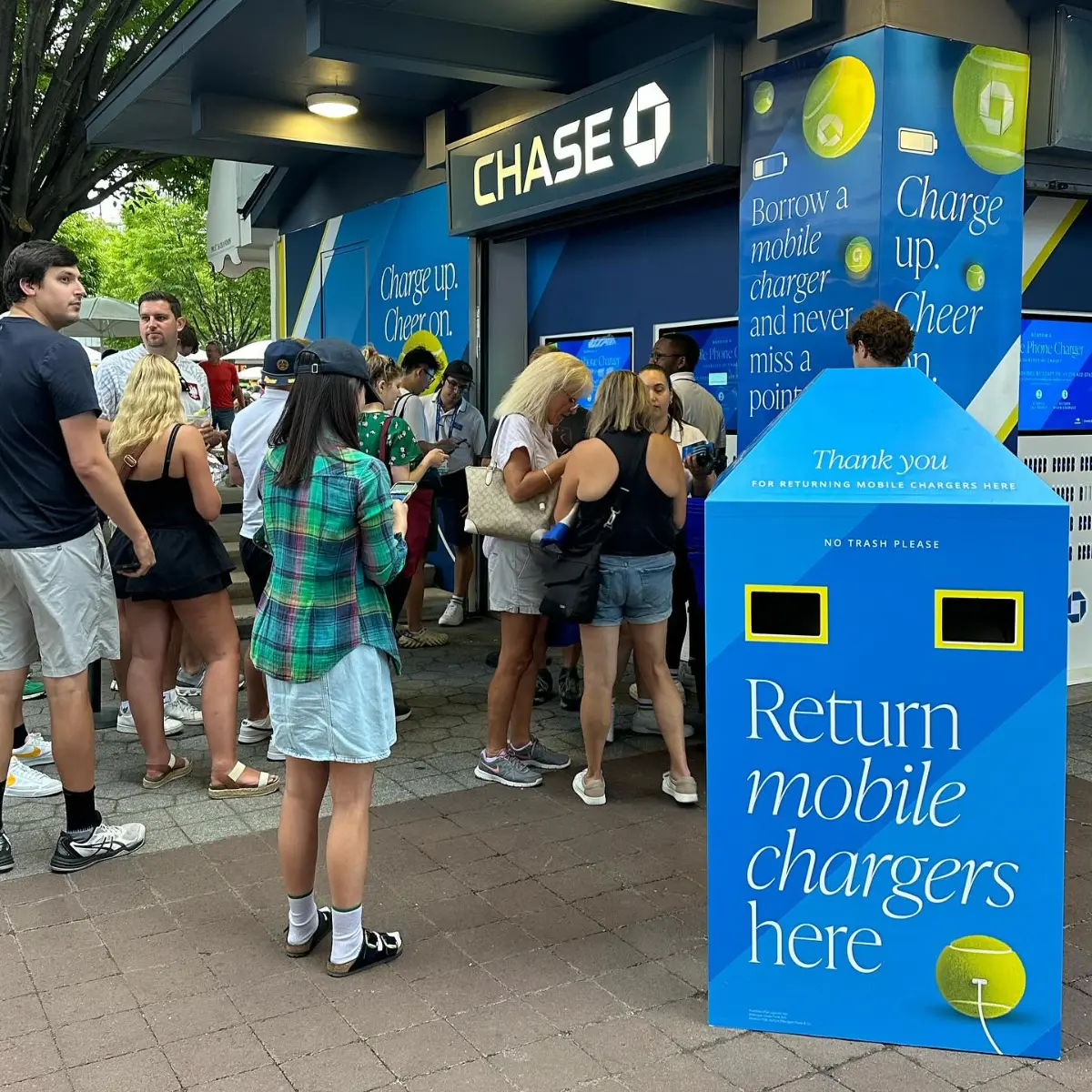
Sponsors already pay for this. A GES sponsorship listing for the AANN Annual Educational Meeting 2019 priced a branded charging station sponsorship at $7,500, production included. Package yours the same way, as one presenting sponsor across every station or one sponsor per zone. A brand partner can also offer free charging as a member benefit, as chargeFUZE's partnership with Chase did for Chase cardholders at events such as the US Open and Lollapalooza. For how screens and sponsors add revenue, read Kiosk revenue beyond rentals.
Quick wins
- Sell stations as a presenting or zone sponsorship
- Send sponsor artwork in time for custom wraps
- Run the agenda on station screens
Step 6: Track usage day by day & adjust
On a multi-day event, day one is your test. chargeFUZE offers post-event data and analytics, so before the show, ask which usage figures you can review while it runs, such as rentals by station and by hour.
Go over them at the end of each day with your venue lead. If one station runs low while another sits full, tell the chargeFUZE team so capacity can follow the crowd tomorrow. If a hall closes before the last day, shift coverage toward registration and the exits.
Afterward, add what you learned to your conference planning checklist: peak hours by day, the busiest stations and the sponsor results. Next year's plan starts there, and so does next year's sponsor pitch.
Quick wins
- Review usage with the team after each day
- Move coverage toward the busiest zones
- Save the report for next year's sponsor pitch
Sources
- Pew Research Center, "Americans' Use of Mobile Devices in 2026" fact sheet (pewresearch.org)
- Monona Terrace Community and Convention Center, Electrical Notice and Terms and Conditions (mononaterrace.com)
- GES, AANN Annual Educational Meeting 2019 sponsorship listing, "Charging Stations" (ges.com)
- chargeFUZE, Events page and FAQs (chargefuze.com)
- chargeFUZE, "The Complete Buyer's Guide to Phone Charging Kiosks for Events and Trade Shows" and "Free Charging With My Card?" (chargefuze.com)
Conference & expo charging questions
Where should a mobile charging station go at an expo?
Where attendees wait and gather: registration, the main entrance, the doors of keynote halls, food and beverage areas and the aisle end caps on the exhibit floor. Spread stations across those zones rather than grouping them in one spot, and keep one near the exits so attendees can drop chargers off on their way out.
Do attendees return power banks at the end of each day?
The rental is built around returns. Attendees can return a charger to any chargeFUZE station at the event, the SMS they receive gives the time to return it by, and a confirmation arrives once it is back. Placing a station near the exits and the shuttle stop makes the end-of-day drop-off part of the walk out.
Can a sponsor brand the charging stations at a conference?
Yes. chargeFUZE offers custom-branded stations and batteries and programmable digital displays for sponsor content, and a brand partner can also offer attendees free charging as a member benefit. Plan on 4 to 6 weeks of notice for custom wraps and branding. To scope it for your event, book your next event with the chargeFUZE team.
Keep reading
All articles