Text +1 (213) 928-7320
Let's chat!

How to Improve Patient Experience in Your Waiting Room
Patients judge a visit long before anyone calls their name. Here are six practical fixes for the waiting room, from honest wait-time updates to charged phones, and how to measure whether they worked.


The verdict
To improve patient experience in your waiting room, tell patients how long they will wait, make the room comfortable and calm, keep phones charged and connected, keep it clean and easy to navigate, and train the front desk to open every visit well. Then measure the results with the same surveys your hospital or clinic is already judged on. None of this needs a renovation, and most of it can start this month.
Why the waiting room shapes patient satisfaction
If you are working out how to improve patient experience, start where most of the visit happens. In a Cornell study of seven outpatient practices at Weill Cornell Medical Center, patients spent approximately three quarters of their visit waiting. For many patients, the waiting room is most of what they remember.
Two terms get used as if they mean the same thing, and they do not. AHRQ, which runs the CAHPS survey program, puts it plainly: “A common misconception is that patient experience and patient satisfaction are the same. They are, in fact, different.” Patient satisfaction asks whether expectations were met. Patient experience asks whether specific things happened, such as clear communication and timely care. The waiting room touches both, and small comforts close the gap between what patients expect and what they get. Our guide on why charging availability lifts satisfaction covers the psychology behind one of them.
- Waits shape trust In an AJMC study of 11,352 Press Ganey survey responses, longer waits lowered confidence in the provider, not just satisfaction with the visit.
- Rooms shape perceived quality Cornell researchers found that more attractive waiting environments correlated with higher perceived quality of care and satisfaction.
- Perception beats the clock Patients tend to overestimate short waits and underestimate long ones, so how a wait feels matters as much as how long it runs.
53% modeled chance of a top “likelihood to recommend” score after a 60-minute combined wait, down from about 77% at 10 minutes (Bleustein et al., AJMC)
Waiting room audit sheet
Use this to walk your own waiting room. Each row maps to a step below.
Area | What patients notice | How to measure it
Wait times | Not knowing how long the wait will be | Share of patients given a delay update
Comfort | Hard chairs, glare and a loud TV | Survey comments on seating and noise
Phones | A dying battery and no free outlet | Outlet requests at the desk, charger rentals
Wi-Fi and screens | A login page that never loads | Wi-Fi sessions at peak, desk questions
Cleanliness and signs | Clutter and confusing directions | Cleaning log, “where do I go?” questions
Front desk | The first hello | CAHPS office staff questions
6 steps to a better waiting room
Step 1: Set honest expectations on patient wait times
Patient wait times are never fully in your control. Whether patients know what is happening is. In a peer-reviewed study of 1,209 emergency department patients in Patient Experience Journal, patients who received no communication about delays were 1.42 to 5.48 times more likely to rate satisfaction lower than very good. The authors concluded that “patients are more likely to accept longer wait times provided their expectations are managed via communication.”
Give the front desk a simple script for the moment a clinic falls behind: how late the provider is running, an honest estimate and when staff will check back. A screen or whiteboard with the current wait works too, as long as someone keeps it current. One more finding from the AJMC study is worth acting on. Satisfaction was more sensitive to time in the exam room than in the waiting room, and the authors advise that when clinics fall behind, “it is better to allow patients to wait outside in the waiting room rather than to quickly place them in an exam room.”
Quick wins
- Script a delay update for the front desk
- Post the current wait and refresh it every hour
- Room patients when the provider is close, not early
Step 2: Fix seating, light & noise
Good waiting room design does not require a renovation. In the Cornell study, the practices with warmer, more attractive settings, such as artwork, modern furniture and residential-style lighting, scored higher on perceived quality of care, satisfaction and staff interaction than the least attractive ones. Earlier research the authors cite found the same pattern for rooms with nice furnishings, artwork and lighting that looked warm.
In a hospital waiting room, start with what patients feel in the first five minutes. Offer a mix of seating, including chairs with arms and clusters where a family can sit together. Swap harsh overhead light for warmer lamps where you can. Keep the TV low or captioned, so the room stays calm and patients can hear their name when it is called.
Quick wins
- Mix seating for families, pairs and solo patients
- Use warmer, softer light where you can
- Caption the TV and turn the volume down
Step 3: Add a hospital phone charging station
Patients and visitors use their phones to update family, read messages and pass the time. A dying battery turns a long wait into a tense one. In an LG survey of 2,000 U.S. smartphone users, nearly nine out of 10 people said they “felt panic” when their phone battery dropped to 20 percent or lower. Meanwhile, waiting room outlets tend to be few, hidden behind a chair or already taken.
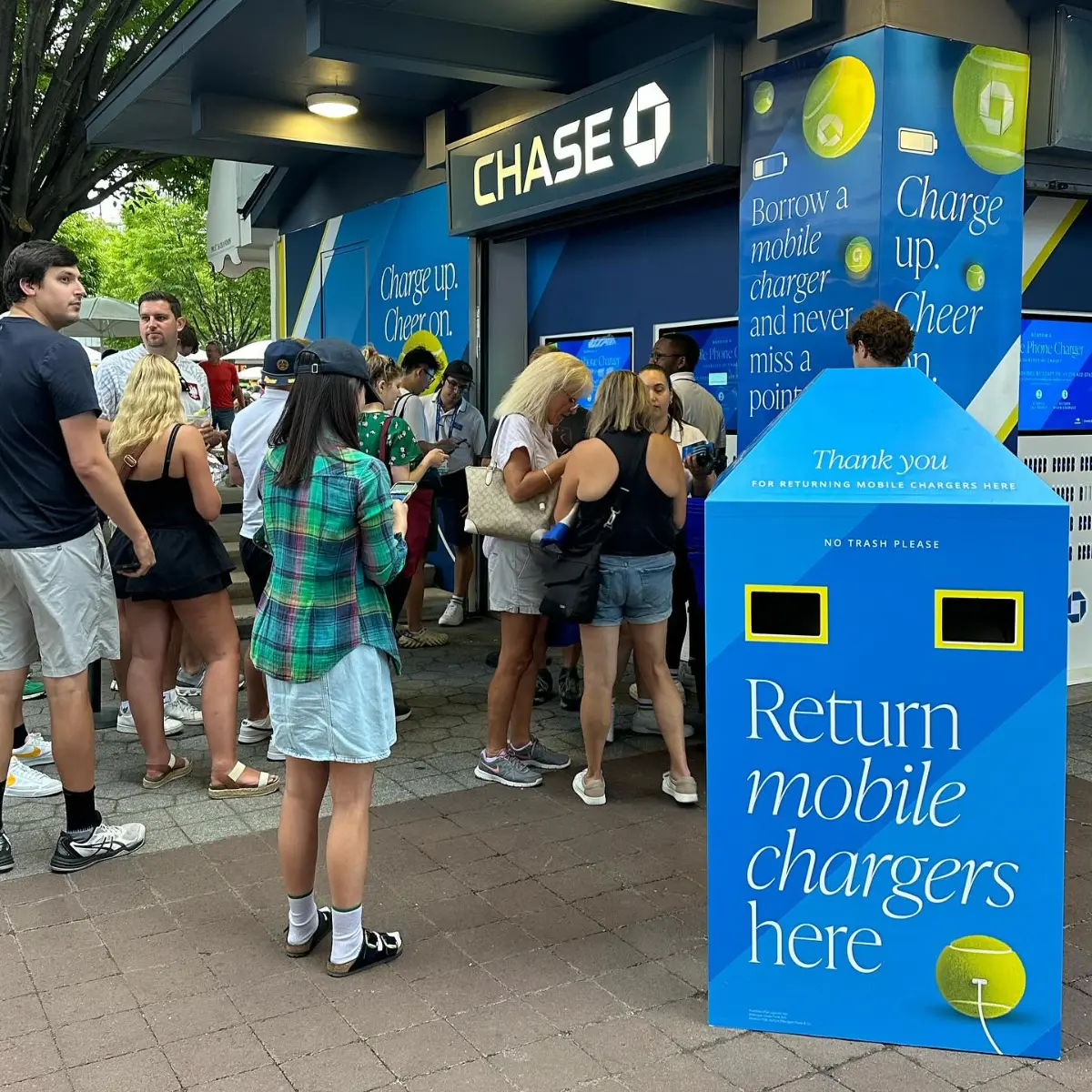
A hospital phone charging station solves this without rearranging the room. Fixed charging stations suit patients who will sit in one spot. Power bank rental kiosks go a step further: a visitor takes a charged portable power bank from the kiosk and keeps it with them. A hospital visitor keeps sitting with their family instead of standing by an outlet, then returns the power bank to any station in the network. Providers like chargeFUZE install and maintain the kiosks and back them with 24/7 support, so front-desk staff do not have to manage them. Compare hospital phone charging station options for your space.
“Since then, the partnership has grown as more kiosks have been added throughout the health system. Hopefully one day all of our hospitals (and beyond) will offer this fantastic service for their patients, families, and team members.”
— Brad Kennedy, Sr Director, Practice & Patient Care Improvement, at a chargeFUZE health system partner
Quick wins
- Place charging within sight of the seats
- Choose portable power banks so visitors can stay seated
- Add stations near cafeterias and family lounges
Sit in your own waiting room for 30 minutes at a busy time, with your phone at 15 percent. Write down every moment you wanted to ask a question, find an outlet or leave. That list is your plan.
Step 4: Offer Wi-Fi & entertainment that works
Free Wi-Fi only helps if patients can get on it. Post the network name and password where people sit, drop sign-up forms that ask for more than an email address, and test the connection from the waiting room at your busiest hour, not from the office down the hall.
Then give people something to do. The AJMC authors suggest that one reason exam room waits feel worse is a “lack of material to engage the patient.” Offer current reading material, a children’s corner, a captioned screen and a short note on what happens next in the visit. Charged phones and working Wi-Fi do a lot of the entertaining on their own, which is why How charging stations extend guest stays is worth a read if your waits run long.
Quick wins
- Post the Wi-Fi name and password at every seating area
- Speed-test from the waiting room at peak
- Add a kids’ corner and captioned screens
Step 5: Keep the space clean & easy to navigate
Cleanliness is one of the things patients are formally asked about. The national HCAHPS hospital survey includes core questions on the cleanliness and the restfulness of the hospital environment, alongside communication with nurses and doctors. A waiting area is not an inpatient room, but patients judge it by the same standard.
Put waiting areas on a visible cleaning schedule during clinic hours: seats, armrests, tables, reading material, the check-in counter and the restrooms. Then walk the route as a first-time patient would, from the parking lot to check-in to the exam room hallway. Every spot where you would stop and ask for directions needs a clear sign in plain language and large type.
Quick wins
- Post a cleaning log with the last check time
- Remove clutter and broken chairs the same day
- Sign every decision point from the entrance
Step 6: Train front-desk staff for the first hello
The front desk sets the tone for everything after it, and patients are asked about it directly. The CAHPS Clinician & Group survey asks how often clerks and receptionists were “as helpful as you thought they should be” and how often they treated patients “with courtesy and respect.” If you want to know how to improve patient satisfaction quickly, start with those two questions.
Train for the first 30 seconds: eye contact, a greeting by name and a clear next step, such as “You’re checked in. The doctor is running about 20 minutes behind, and I’ll update you at 2:30.” Give staff the authority to fix small problems on the spot, like a quieter seat, a blanket or directions, without finding a manager first.
Quick wins
- Greet every patient within seconds of arrival
- Pair every check-in with a clear next step
- Role-play the delay update in staff huddles
Measure results with HCAHPS & surveys
According to CMS, HCAHPS is “the first national, standardized, publicly reported survey of patients’ perspectives of hospital care.” It covers inpatient stays, while clinics and outpatient practices usually use the CAHPS Clinician & Group survey, which includes the front-desk questions above. For a plain explanation of what these surveys measure and why experience differs from satisfaction, start with AHRQ's CAHPS patient survey guide.
Survey results arrive slowly, so pair them with weekly numbers you control: the posted wait versus the actual wait, the share of patients who got a delay update, cleaning log completion and, if you add charging, power bank rentals per day. Change one thing at a time and give each fix a few weeks before you judge it.
Sources
- AHRQ, What Is Patient Experience?
- Bleustein et al., Wait Times, Patient Satisfaction Scores, and the Perception of Care, AJMC (2014)
- Becker and Douglass, The Ecology of the Patient Visit, Journal of Ambulatory Care Management (2008)
- Shah et al., Managing Patient Expectations at Emergency Department Triage, Patient Experience Journal (2015)
- CMS, HCAHPS: Patients’ Perspectives of Care Survey
- CG-CAHPS core items, Medical Care (2016), via PubMed Central
- LG Electronics USA via PR Newswire, “Low Battery Anxiety” Grips 9 Out of Ten People
Waiting room questions
What are good waiting room ideas for a medical office?
The best medical office waiting room ideas are simple: honest wait-time updates, comfortable mixed seating, warmer lighting, working Wi-Fi, a way to charge phones, a children’s corner, clear signs and a friendly front desk. Start with the waiting room ideas that remove the most common frustrations before you spend on decor.
How do you reduce patient wait times?
To reduce patient wait times, track the gap between each appointment time and the time the patient is actually seen, find where visits back up (check-in, rooming or the provider schedule), and fix the biggest bottleneck first. While you work on it, tell patients how long they will wait. In one emergency department study, patients who heard nothing about delays were 1.42 to 5.48 times more likely to rate their satisfaction lower than very good.
Do patients want phone charging in waiting rooms?
Few surveys ask patients directly, but the signs are strong. In an LG survey, nearly nine out of 10 smartphone users said they felt panic at 20 percent battery or lower, and phones are how patients and visitors stay in touch with family during a visit. Health systems that try charging kiosks tend to keep them: a chargeFUZE health system partner says more kiosks have been added throughout the health system since its pilot.
Keep reading
All articles